

On October 16, 2026, WooCommerce merged pull request #69787 into its core repository, deleting ITS OWN Model Context Protocol (MCP) endpoint and the packages it had bundled to run it. WooCommerce built that endpoint itself back in May 2026, months before the official WordPress tooling for AI agents was ready for daily use. Five months later, with that tooling now stable, WooCommerce tore its own version out rather than keep maintaining two copies of the same thing. Let’s walk through what happened together!
We’ve already covered the three building blocks that make any of this possible: WordPress’s Abilities API, AI Client, and MCP Adapter. WooCommerce is the extension that leaned on those pieces earliest, and it just became one of the first to publicly retire its own workaround for them.
Why WooCommerce built its own endpoint in the first place
On May 12, 2026, WooCommerce’s developer blog introduced seven canonical abilities for products and orders: querying, creating, updating, and deleting products, plus querying orders, updating their status, and adding notes to them. These abilities ran on WordPress’s own Abilities API, core’s generic mechanism for registering actions an AI agent can call. WooCommerce exposed them two ways: through the standard REST path at /wp-json/wp-abilities/v1/abilities/, and through WordPress’s shared MCP endpoint at /wp-json/mcp/mcp-adapter-default-server. WooCommerce 10.9 shipped with all seven abilities on June 23, 2026.
To avoid breaking anyone still on the older setup, WooCommerce also kept its own MCP endpoint running in parallel, at /wp-json/woocommerce/mcp, and bundled its own copies of the MCP Adapter and Abilities API as Composer packages rather than relying on the official WordPress.org plugin. That made sense while the official plugin was still young, but it also meant WooCommerce was shipping and maintaining a private copy of code that belonged to the wider WordPress ecosystem, not to WooCommerce. We’ve also seen Elementor lean on the same shared stack for turning Figma designs into WordPress pages through an AI agent, so WooCommerce was never going to be the only plugin facing this choice.

What pull request #69787 actually removes
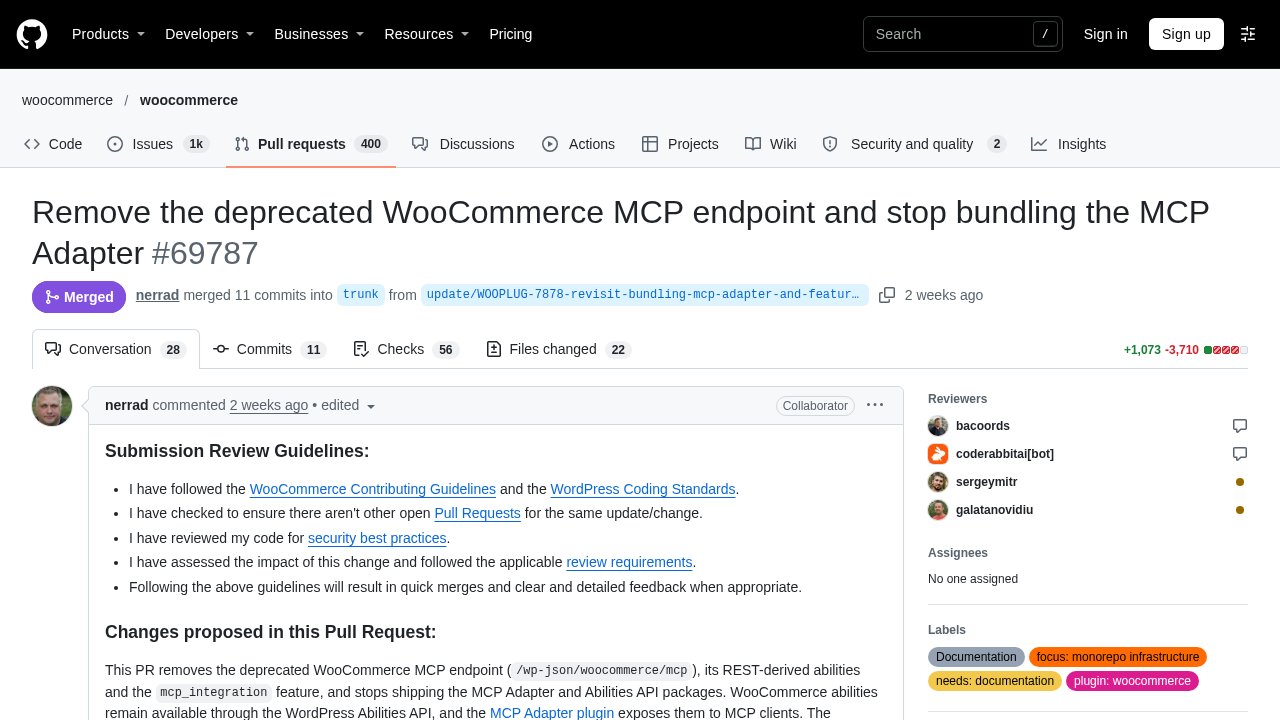
The pull request that merged on October 16 does three concrete things. It removes the deprecated /wp-json/woocommerce/mcp endpoint entirely. It stops bundling the MCP Adapter and Abilities API as Composer packages inside WooCommerce. And it drops the mcp_integration feature flag that used to switch the old setup on and off. WooCommerce’s stated reason is straightforward: the official MCP Adapter plugin, now at version 0.7.0, deprecated being embedded as a Composer library, and WordPress 7.0 and later ship the Abilities API natively. Keeping a WooCommerce-only copy of both had become redundant work for no real benefit.
The seven canonical abilities themselves are not going anywhere; they stay active by default. What changes is how a client reaches them: through the official, shared WordPress plugin, not through a WooCommerce-specific shortcut.
What this means if you still call the old endpoint
WooCommerce’s developer blog spelled out the migration on October 21, 2026: any integration still pointed at /wp-json/woocommerce/mcp with a plain REST API key needs to move to the official MCP Adapter plugin, authenticated with a WordPress Application Password instead. We’ve already written about why handing out an Application Password deserves more care than most site owners give it, and that advice applies directly to whoever sets this connection up. Store owners who never touched the old maison endpoint do not need to do anything: the seven abilities keep working through the adapter once it is active, with no separate WooCommerce-specific setup required.
WooCommerce 11.3 is still in beta, with a stable release due the week of November 9
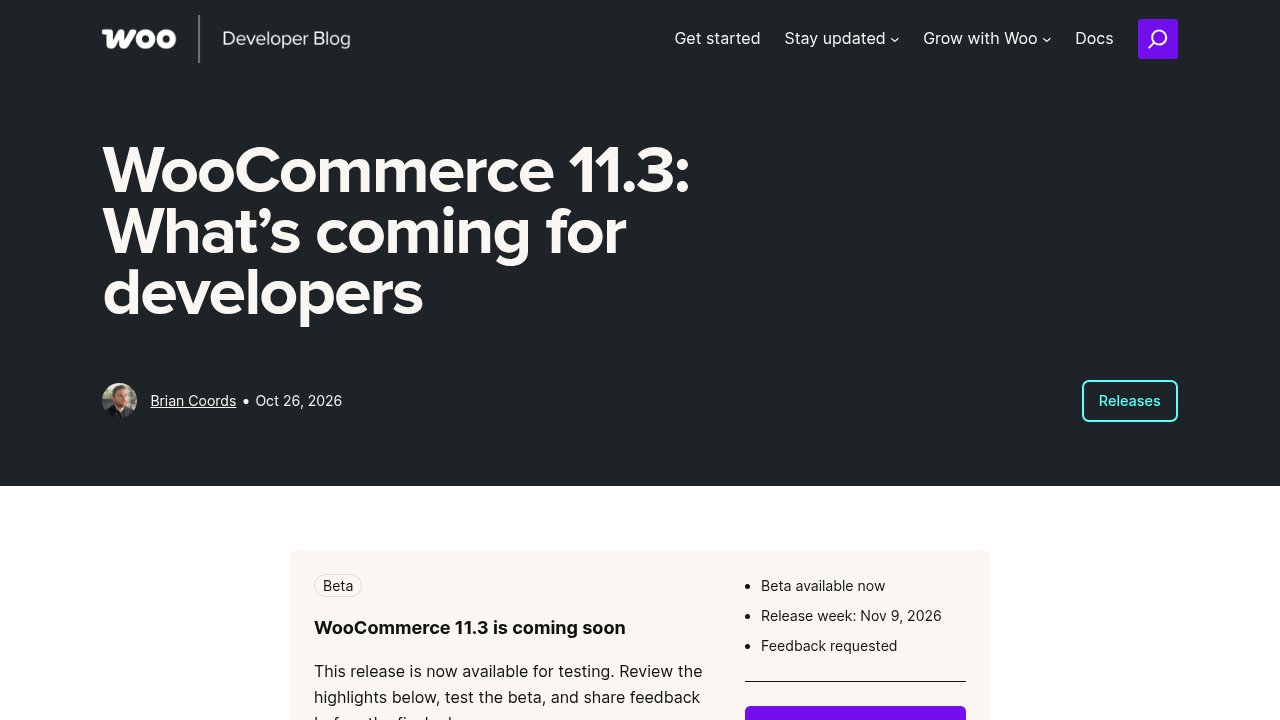
As of this writing, WooCommerce 11.3 is available as a beta for testing, not as a finished release. WooCommerce’s own pre-release post, published October 26, 2026, lists this removal among what is coming for developers and sets the stable release for the week of November 9, 2026. If you are reading this after that week, check the actual release notes for the final date rather than taking “coming soon” at face value.
Our take
Beyond the version history, the real lesson here is about restraint. WooCommerce built a working MCP endpoint early, when the standard tooling was not ready yet, and that was a reasonable call at the time. What is worth noticing is how quickly it gave that workaround up once the standard caught up: five months between introducing its own copy and retiring it for good. If you maintain a plugin, that is the model worth copying: build a bridge if you must, but treat it as a bridge, not a feature, and drop it the moment the official package can carry the weight.
If you still call /wp-json/woocommerce/mcp directly, switch to the MCP Adapter plugin and an Application Password on a staging copy of your store before WooCommerce 11.3 goes stable. If none of this sounds familiar, you were already on the standard path, and nothing changes for you.
Photo: Josh Sorenson / Pexels.