

Three months after WordPress folded its first piece of AI infrastructure, the AI Client we already walked you through, into its own core, the project took a public stance on AI policy. WordPress.org announced on August 27, 2026 that it has signed Open Weights and American AI Leadership, an open letter asking US policymakers not to place early restrictions on open weight AI models. Let’s go through what WordPress actually signed, and why the timing is the real story here.
What does “open weight” actually mean, and what is the letter asking for?
An open weight model is one whose trained parameters anyone can download, inspect, modify, and run on their own hardware, without going through the company that trained it. That is different from OPEN SOURCE, the licensing model behind WordPress’s own code: open source concerns who can read and redistribute source code, open weight concerns who can access a model’s trained parameters. The two ideas share a philosophy, downloadable and inspectable beats locked away, but they are not the same technical thing, and the letter is squarely about the second one.
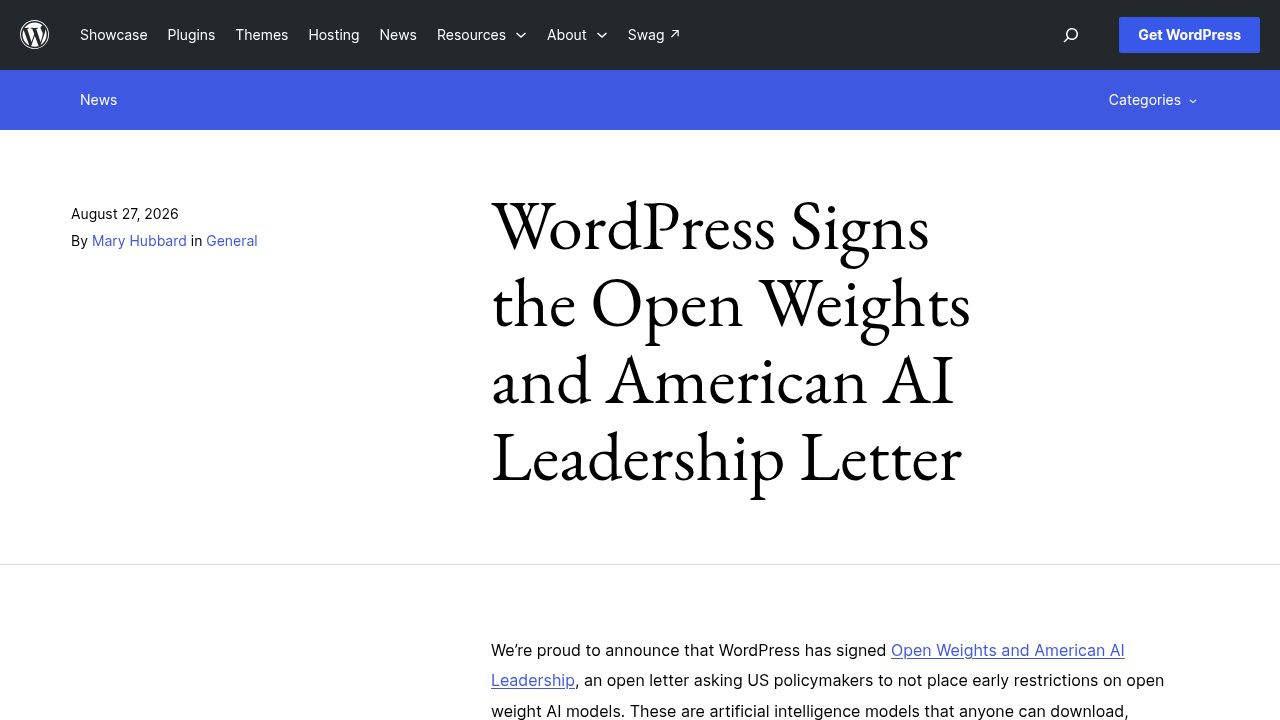
WordPress explained its own reasoning in plain terms: “technology gets better and safer when more people can study it and build on it.” The announcement adds that “anyone can run the software, look at how it works, change it to suit their needs, and share what they make,” a description that could just as easily describe WordPress’s own code. The letter itself, hosted on microsoft.com since Microsoft is one of its founding signatories, asks policymakers for four concrete things: expand computing access for startups and researchers, invest in shared training resources like datasets and evaluation tools, keep the field of frontier AI development plural by avoiding premature restrictions on open models, and use targeted rules rather than blanket bans to address genuine misuse, without confusing that with legitimate techniques like distillation.
The timing that actually matters: WordPress signed over a month late
Here is what most coverage of WordPress’s signature missed: this letter did not appear on August 27 with WordPress attached to it. It launched on July 24, 2026, a date confirmed on both the WordPress announcement and Microsoft’s own page. Reporting from that week put the original signer count at around 25 organizations, among them Microsoft, NVIDIA, Meta, IBM, Dell, Palantir, Andreessen Horowitz, Hugging Face, Mozilla, and the Linux Foundation. That same coverage noted a detail that got attention at the time: OpenAI, Anthropic, and Google were missing from the original list. OpenAI and Google added their names the very next day, alongside Cloudflare; Anthropic did not sign.
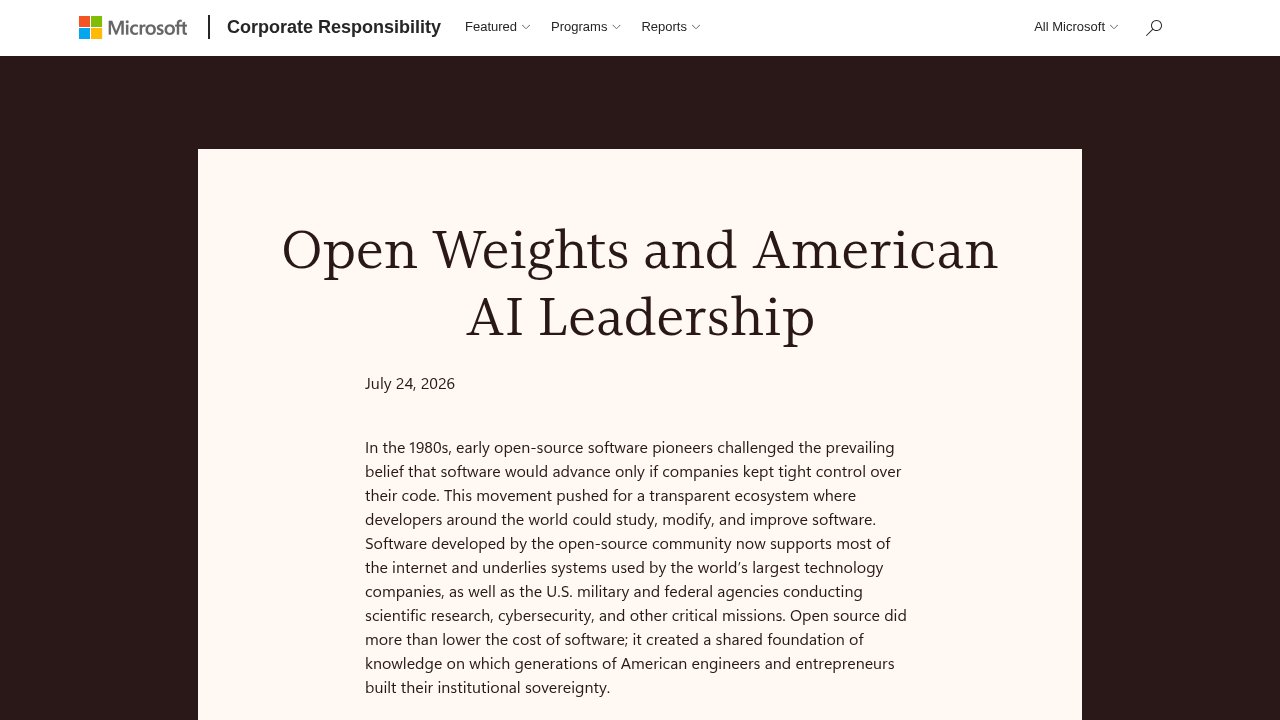
By August 3, 2026, the letter’s own page counted more than 270 signing organizations, a figure Microsoft’s page still confirms directly. WordPress joined on August 27, more than a month after the launch and weeks after the fastest growth had already happened. That is a meaningfully different move than being one of the 25 names that set the letter in motion, or even one of the hundreds that piled on in the first two weeks. It reads less like a project racing to be seen taking a stance, and more like one that took its time deciding whether to add its name at all.
Why does an open-source CMS care about AI model regulation?
WordPress does not train AI models, so on its face this is a strange fight for a CMS project to wade into. The connector, and this is our reading of the situation rather than anything WordPress itself has stated, is the infrastructure the project has been quietly building since WordPress 7.0 “Armstrong” shipped in May 2026: the AI Client, the Abilities API, and the MCP Adapter, the three building blocks we covered in detail here. That infrastructure was built to let WordPress talk to AI models generally, and an open weight model is one of the few kinds you can point a self-hosted WordPress site at without routing every request, and every bit of site data, through a third party’s API.

Regulation that made open weight models harder to obtain or run would not touch WordPress’s code, but it could narrow the set of models an agency, a developer, or a self-hosted site owner is actually allowed to point that infrastructure at. Whether WordPress’s AI infrastructure ends up leaning on open or closed models is not decided yet, and the letter does not settle that either way. It only asks that the option stay on the table. Framed that way, an open-source CMS caring about open weight AI availability is less of a stretch than it first sounds, even if WordPress has not spelled out this connection itself.
Our take
Nothing about this signature changes what you can do in wp-admin tomorrow morning: there is no new setting, no new plugin requirement, no compatibility box to check before your next update. What it does show is a WordPress project willing to spend some of its public voice on an AI policy fight it did not start and was in no hurry to join, once it had presumably decided the OPEN WEIGHT side of that fight lines up with the same instincts that keep WordPress’s own code open. We would treat this the way we treat most organizational stances: worth knowing, not worth acting on. If you are curious where WordPress’s own AI ambitions actually stand today, our walkthrough of what shipped in WordPress 7.0 “Armstrong” is the place to see the AI Client in context, not just this one letter about it.