

In September 2026, Crocoblock added a new plugin to its JetPlugins suite: JetGEO, built around one question, how does a WordPress site look to an AI system that never asks a human for directions? We already mapped the pieces WordPress ships on purpose for AI, the Abilities API, AI Client, and MCP Adapter that make WordPress agentic. JetGEO works in the opposite direction: instead of inviting an AI agent in, it manages what AI crawlers see when they show up uninvited. Crocoblock is not the first to build this, free plugins on wordpress.org have covered pieces of it for a while, and a large-scale study of real server logs published a few months earlier raises an honest question about whether any of it changes anything. Let’s walk through what JetGEO actually controls, and what the data says.
What does an llms.txt file actually do?
An llms.txt file is a Markdown document placed at the root of a domain, listing a site’s most important pages and a short summary of each, written for language models rather than for human visitors. Jeremy Howard proposed the format in September 2024, and it remains a de facto convention rather than a formal standard, not something ratified by a body like the W3C or IETF. The specification itself is still described as “open for community input.” That has not stopped it from spreading. Howard released a v2 of the spec in August 2026, citing two years of real-world adoption, and major organizations including Anthropic and Cloudflare now publish their own llms.txt files alongside their regular sitemap.
The comparison WordPress users reach for is robots.txt, and it is a useful one up to a point. Both files sit at the domain root and address automated visitors rather than people. The difference is intent: robots.txt tells a crawler where it may go, while llms.txt tells a language model what matters once it arrives. Neither file forces anything. Whether a given AI system reads one, respects it, or even checks for it is entirely up to that system, a distinction that turns out to matter a great deal once you look at what actually shows up in server logs.
What does JetGEO 1.0.0 actually add?
JetGEO, according to Crocoblock’s own product page, generates and keeps an llms.txt file up to date, with customizable templates and an AI assistant built in to help draft the content. It also manages robots.txt rules specifically for named AI crawlers, allowing or blocking individual bots without touching the rules a site already has for conventional search engines. A third piece converts selected pages, posts, and products into clean Markdown aimed at AI consumption, and a monitoring table logs AI crawler visits, which request, which page, what the site served back. The plugin runs independently of any page builder, so it works the same way on an Elementor site or a block-theme site.
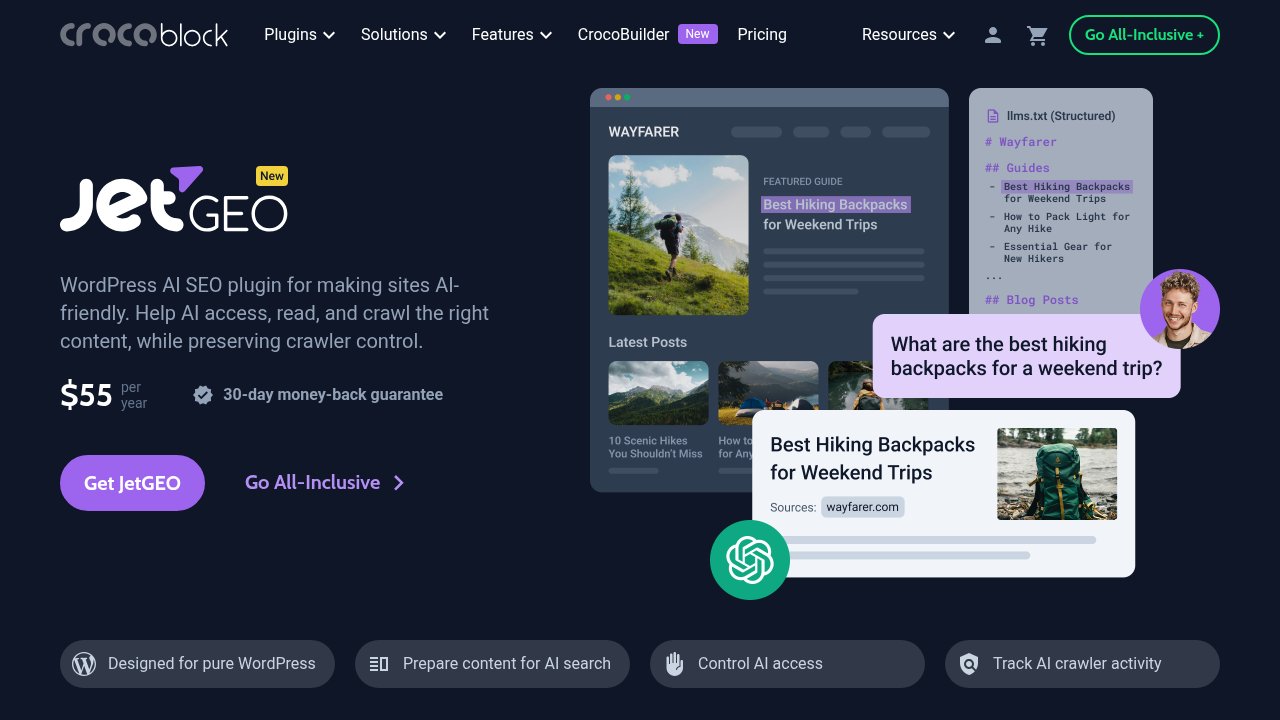
Pricing sits at $55 a year for a single site, discounted to $42 a year at the current launch rate, with a 30-day money-back guarantee attached. Sites already paying for Crocoblock’s All-Inclusive Plus bundle, $249 a year for 23 plugins, get JetGEO included, as do Lifetime license holders. None of that is unusual for a JetPlugins release. What is worth noting going in: every one of JetGEO’s four core functions, generating llms.txt, managing robots.txt per bot, exposing Markdown, and logging crawler visits, already exists somewhere on wordpress.org for free.
Can you already do most of this for free?
The honest answer is yes, in pieces. Website LLMs.txt, built by Ryan Howard, is installed on more than 40,000 active sites and generates a structured llms.txt file that plugs directly into Yoast SEO, Rank Math, SEOPress, and AIOSEO, automatically leaving out anything those plugins have already marked noindex or nofollow. LLMagnet covers similar ground for roughly 500 active sites. On the crawler-detection side, LLMs.txt Curator identifies named bots, GPTBot, ClaudeBot, PerplexityBot, Google-Extended, by name, though its own install count stays modest, just over 100 active sites, a sign that this particular piece of the puzzle still has few takers. A fourth plugin, WPG AI Crawler Manager, covers robots.txt rules for AI bots specifically and counts fewer than 10 active installs.
What JetGEO actually centralizes is the combination, one paid tool with one support line, rather than any single capability that did not already exist for free. For a site owner already running three or four specialized free plugins and tired of updating them separately, that consolidation has real value. For a site that just wants an llms.txt file, the free option with 40,000 installs behind it does the core job already.
Does any of this actually change how AI sees your site?
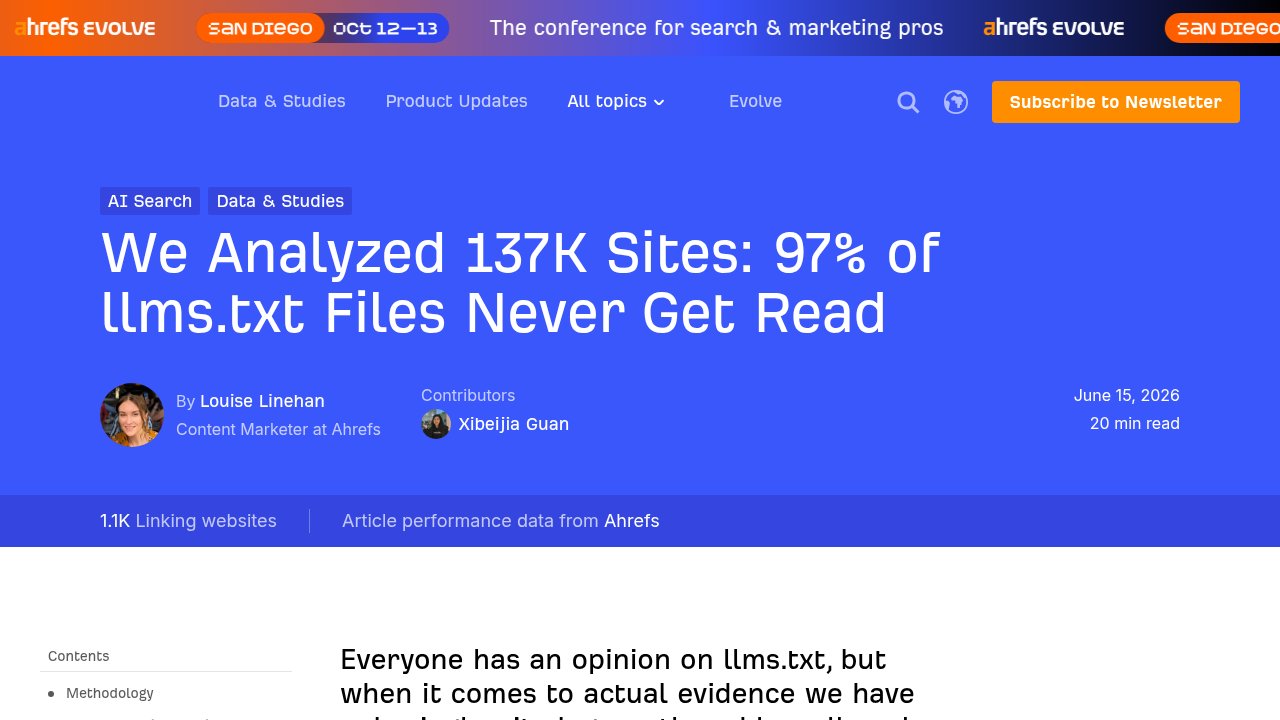
This is the question neither Crocoblock nor any free plugin’s description answers, and it is the one a study Ahrefs published in June 2026 actually measured. Ahrefs pulled server logs and crawler analytics from 137,210 domains for May 2026. 28% of those domains, 38,360 sites, already published an llms.txt file, and 97% of those files received zero requests during the entire month. Roughly 1,100 domains saw any traffic to their file at all.
The requests that did land are not what a vendor pitch would predict. Of about 22,000 total requests Ahrefs logged across the whole sample, named AI crawlers combined, GPTBot, Claude-Code, PerplexityBot among them, accounted for only 19.5% of the traffic, while SEO audit tools alone sent 21.7%, more than every AI crawler put together. GPTBot’s training crawler made up 4.51% on its own; OAI-SearchBot led the pack of AI retrieval bots at 0.74%, with PerplexityBot, alongside it and Claude’s search crawler, logging only a couple hundred fetches combined across thousands of sites. The single largest named bot was Claude-Code, Anthropic’s coding agent, which logs a request when a developer points it at a URL rather than when an AI company autonomously crawls the open web, a meaningfully different kind of visit than the vendor pitch implies. Ahrefs’ other finding cuts the other way just as hard: domains without an llms.txt file get zero probing requests for one. AI bots are not checking whether a site has one. They are not looking.
That is not quite the same claim as “llms.txt does nothing.” Anthropic and Cloudflare publishing their own files shows real investment on the production side of the format. What Ahrefs measured is consumption, whether anyone’s crawler actually asks for the file once it exists, and on that count the evidence is thin. THE question JetGEO and every free alternative leave unanswered isn’t whether a plugin can generate the file in five minutes. It’s whether anything out there is reading it.
Should your WordPress site set up llms.txt now?
Setting one up is cheap enough that the Ahrefs numbers are not really an argument against doing it, they are an argument against expecting much from it. If your site already runs Yoast, Rank Math, SEOPress, or AIOSEO, Website LLMs.txt plugs in for free and takes a few minutes to configure. Treat the result as basic technical hygiene, not as a visibility strategy with a measurable return.

JetGEO earns its price for a narrower group: sites already paying for Crocoblock’s All-Inclusive Plus bundle, where it costs nothing extra, or site owners who specifically want the robots.txt-per-bot controls and the crawler monitoring table in one place with support attached, rather than stitching together three specialized free plugins themselves. Before paying for any of it, check whether your own logs show AI crawler traffic worth managing in the first place; Ahrefs’ data suggests most sites will not find much.
Our take
llms.txt has become normal technical hygiene for a WordPress site in 2026, and JetGEO handles it competently if you already pay for the Crocoblock ecosystem. What it is not, on the best evidence available right now, is a proven lever for AI visibility. We gave the same caution about WP Trend Watcher, an AI tool built to need a human reviewer rather than replace one: an automated table of numbers is not a substitute for checking what your own site actually shows. If you set up llms.txt, free or paid, look at your server logs a month later. Ahrefs’ data says there is a 97% chance nothing changed, and that is worth knowing before you count on it for anything more than tidy housekeeping.
Photos: Vladimir Srajber, TREEDEO.ST / Pexels.